A Brewery Within a Hill
Industrial Architecture and Ecological Infrastructure Integration
Role: Project Architect and Systems Designer
Type: Concept Proposal — Industrial Architecture and Landscape Design
Stack: Rhino, Grasshopper, Revit, environmental analysis, structural systems
Location: South Korea
Overview
A Brewery Within a Hill is a conceptual architectural proposal integrating industrial production with ecological landscape systems. Designed for a forested slope in rural South Korea, the project embeds brewery infrastructure within hillside topography, treating architecture as mediating apparatus between manufacturing processes, hydrological cycles, and forest regeneration rather than object imposed upon passive site.
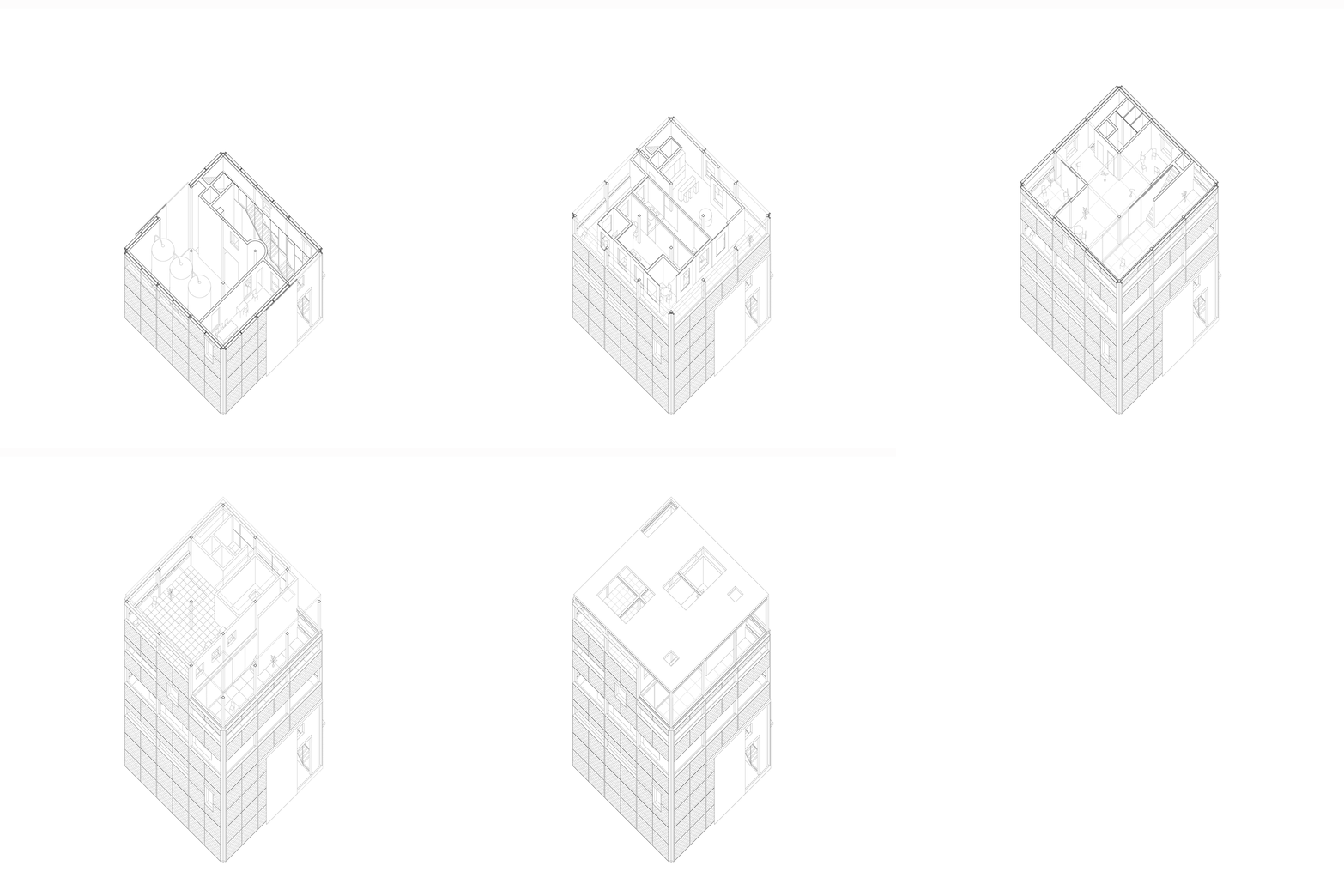
The design employs flexible modular grid calibrated to both industrial requirements (grain handling, fermentation vessel spacing, gravity-fed material flow) and ecological constraints (tree spacing, erosion control, runoff management). Porous brickwork façade functions as environmental membrane regulating interior humidity, admitting filtered light, and supporting moss/lichen colonization. Structural system designed for reversibility—steel-and-brick framework enabling reconfiguration as production scales or landscape evolves.
Industrial architecture as ecological operator: production and environment coordinated through single adaptive system.
Project Context
Rural South Korea faces dual challenges: agricultural decline in hinterland regions and forest degradation from erosion and neglect. Industrial development typically exacerbates environmental pressure through site clearing, hydrological disruption, and resource extraction. Conventional brewery architecture treats landscape as buildable surface requiring flattening, drainage engineering, and separation from production processes.
Design challenge: develop industrial architecture functioning as ecological infrastructure rather than environmental burden. This required integrating building systems with landscape processes (water management, slope stabilization, forest succession), calibrating production layouts to topographic constraints rather than imposing geometric regularity, and designing reversible construction enabling future adaptation without demolition waste.
Proposal needed to demonstrate how manufacturing facility could support rather than degrade ecological systems while maintaining operational efficiency comparable to conventional industrial construction.
Design Strategy
A Brewery Within a Hill integrates industrial requirements with landscape processes through coordinated architectural-ecological systems:
Topographic integration (Rhino, Grasshopper terrain modeling):
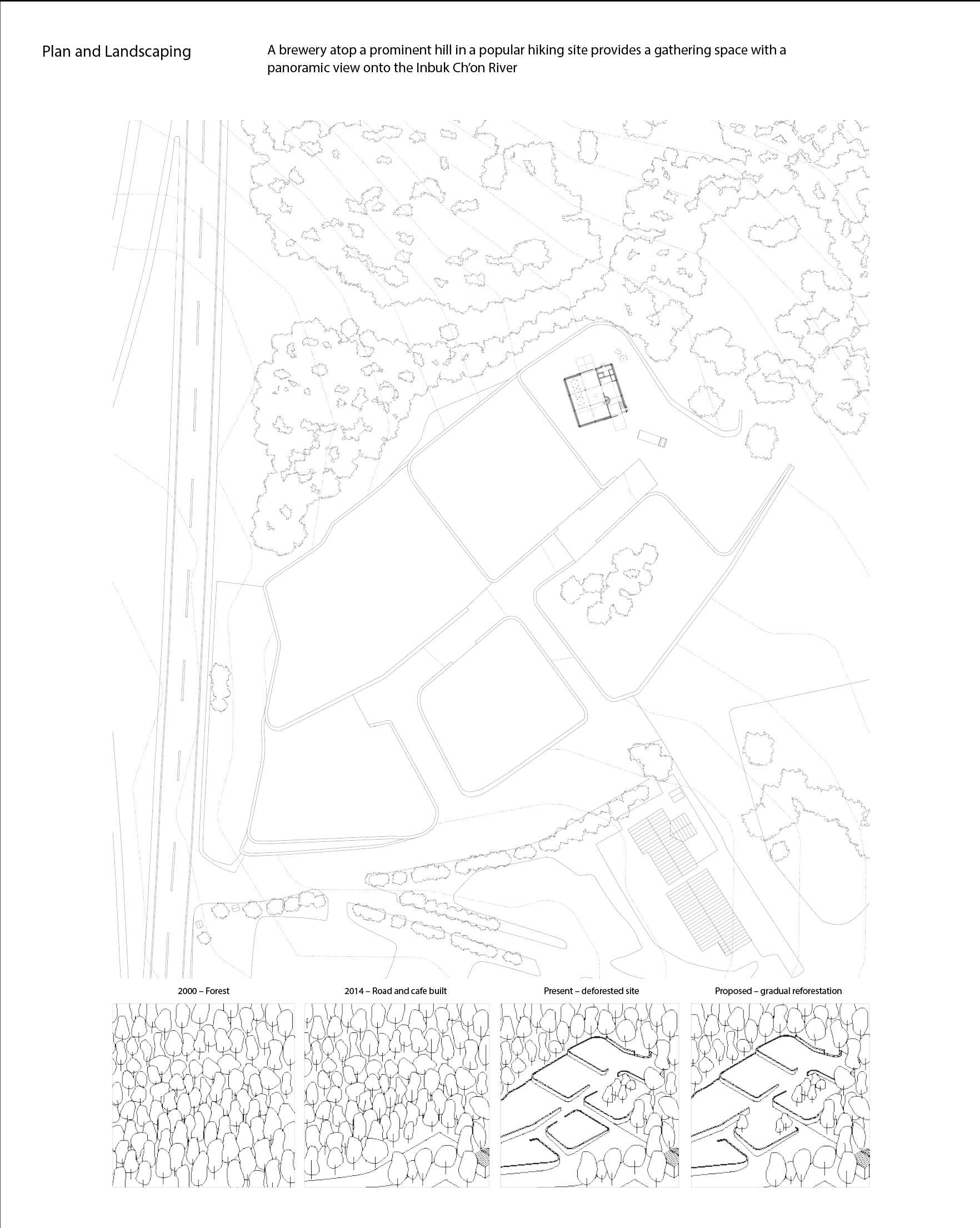
Rather than flattening site, building follows existing slope contours embedding structure within hillside. Grasshopper parametric workflows tested how different grid orientations and module sizes respond to topographic variation, optimizing for minimal earthwork while maintaining operational efficiency. Result: building section leveraging gravity for material flow (grain delivery at upper level, fermentation mid-level, packaging lower level) reducing mechanical handling requirements.
Structural system designed as prosthesis stabilizing slope rather than independent object. Foundations function as erosion control, transferring building loads while managing runoff and preventing downslope soil movement. Integration approach treating construction as hydrological intervention rather than geological imposition.
Modular flexibility (Revit coordination, structural systems):
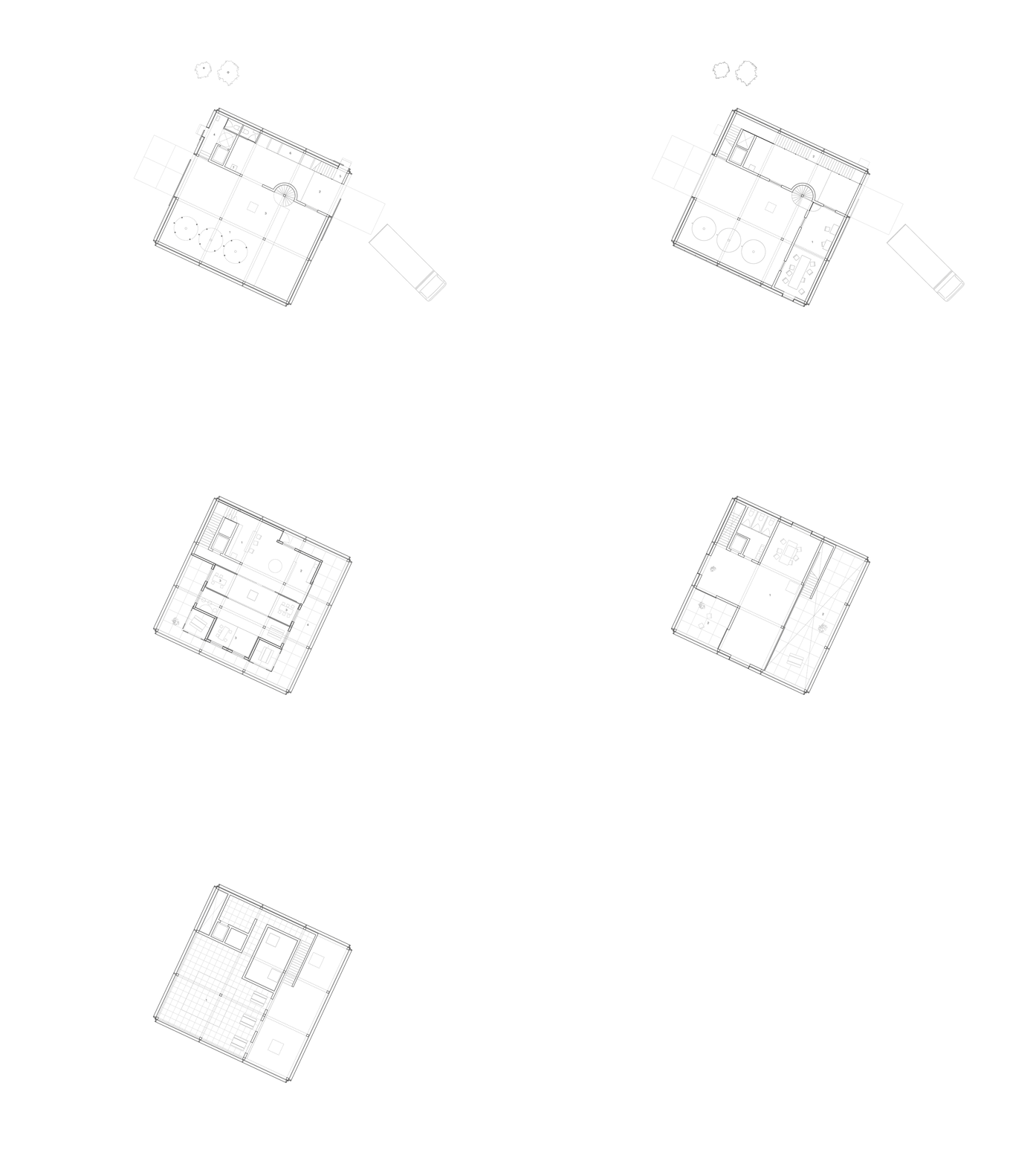
Grid system (6m × 6m module) calibrated to multiple constraints simultaneously: fermentation vessel spacing (industrial), tree spacing for reforestation (ecological), material handling equipment dimensions (logistical). Revit coordination ensuring structural grid accommodates both current program and future expansion/contraction scenarios.
Modularity enabling phase construction aligned with business development and seasonal cycles. Initial phase establishing core production facilities, subsequent phases adding capacity or converting to alternative programs as market/environmental conditions evolve. Design anticipates uncertainty through adaptable infrastructure rather than fixed configuration.
Porous brick envelope (environmental performance analysis):
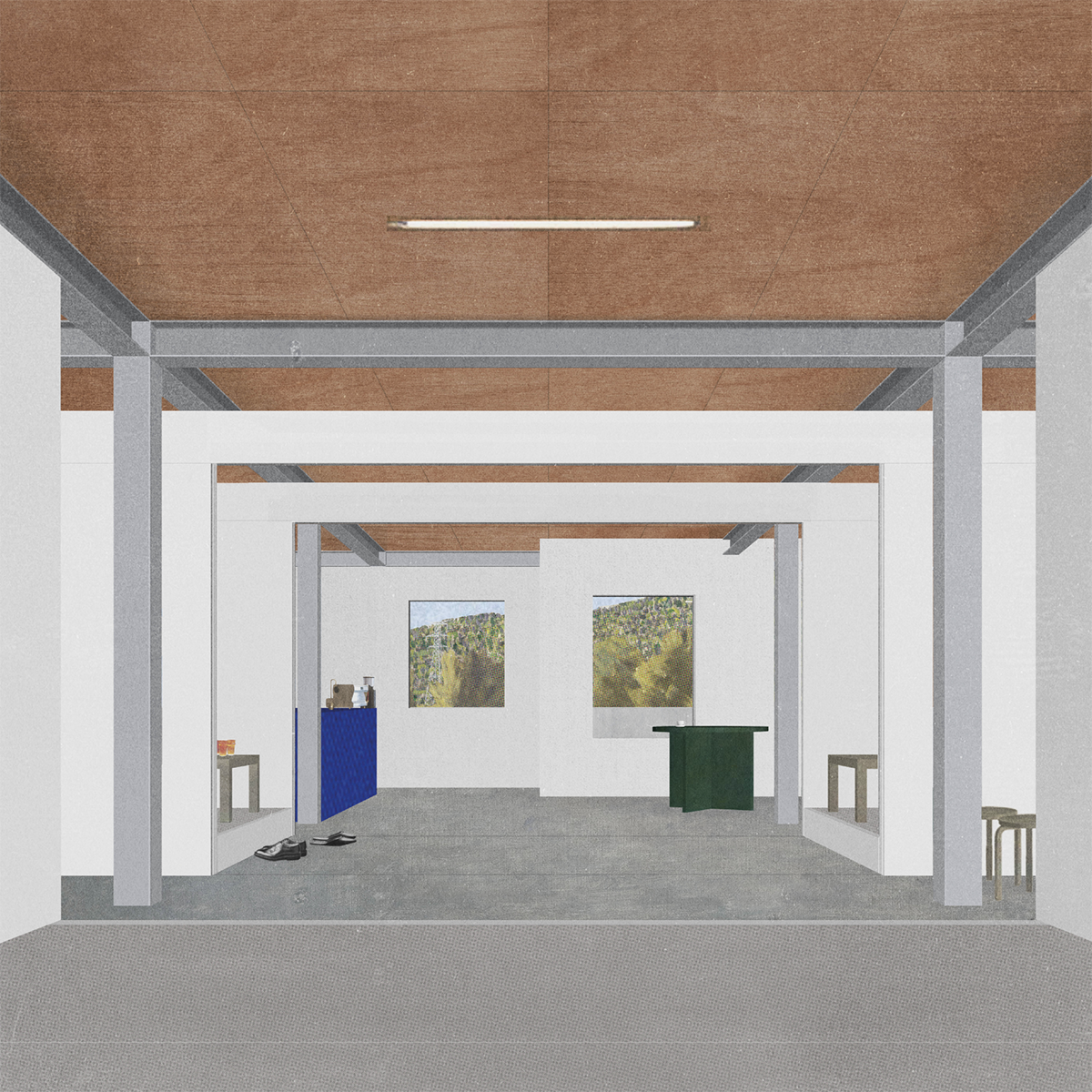
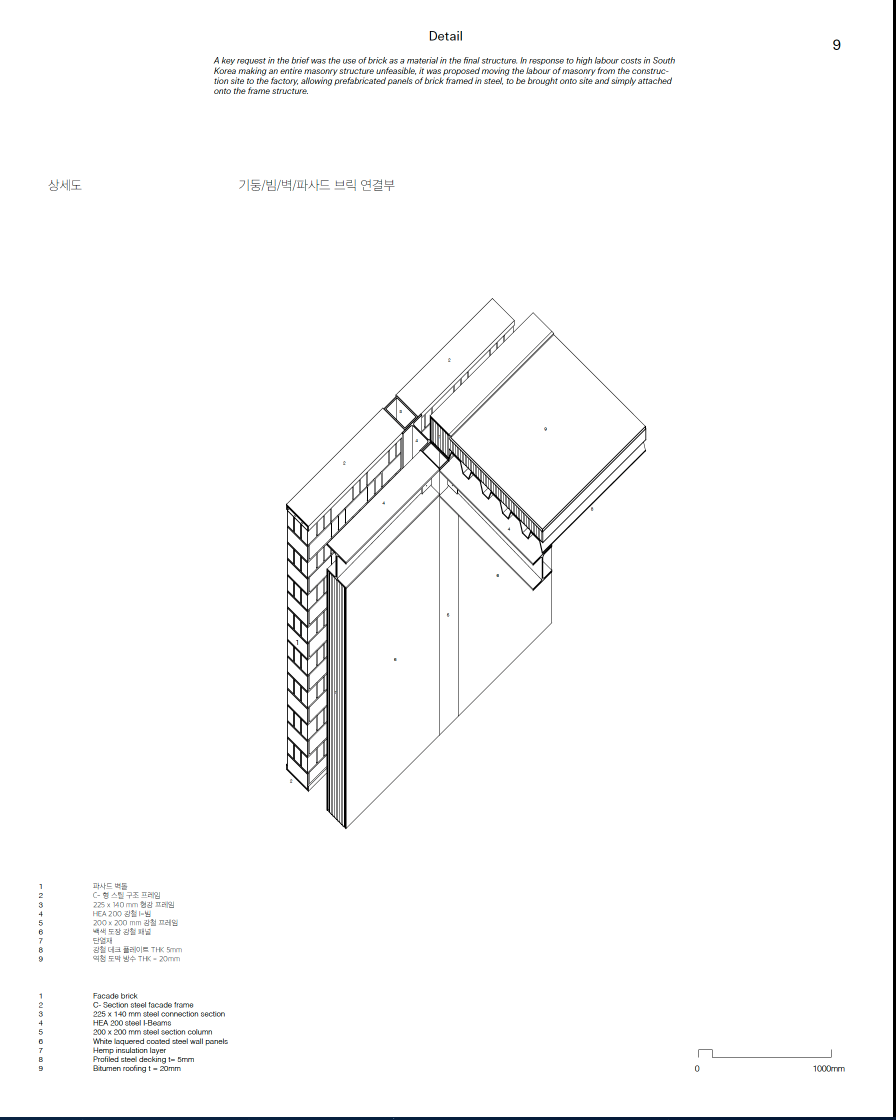
Façade system using perforated brickwork achieving multiple functions: structural enclosure, environmental regulation, ecological substrate. Brick pattern variations (40-60% porosity) calibrated to orientation and program—higher porosity on south/west for solar shading and ventilation, lower porosity on north for thermal retention.
Porous surface regulating interior humidity critical for fermentation processes while reducing mechanical HVAC requirements. Brick moisture absorption/release buffering daily humidity fluctuations. Texture and porosity supporting moss and lichen colonization, transforming façade into living membrane providing additional thermal insulation and air filtration as ecosystem matures.
Environmental analysis testing thermal performance, daylight penetration, and natural ventilation patterns under different brick configurations, optimizing porosity percentages for interior comfort without mechanical systems.
Gravity-fed circulation (section design):
Building section organized enabling gravity-assisted material flow: grain storage at upper level flows down to milling, milled grain drops to mash tuns, wort gravity-feeds to fermentation vessels, finished product descends to packaging. Circulation design minimizing pumping requirements reduces energy consumption and mechanical failure points.
Human circulation following similar logic: visitor entry at upper level (café, viewing platforms), production observation mid-level, drinking halls at lower level. Sectional organization aligning industrial efficiency with experiential narrative—visitors descend through production process understanding beer-making sequence.
Hydrological integration:
Roof drainage directing runoff to retention systems irrigating adjacent reforestation areas. Gutters doubling as irrigation infrastructure, building envelope managing water as resource rather than waste. Permeable ground surfaces enabling infiltration while structural foundations channeling excess flow preventing erosion.
Design treating water as material connecting building systems to landscape processes—brewery water consumption, wastewater treatment, and stormwater management integrated into site hydrology rather than requiring separate engineered solutions.
Social infrastructure (Korean Pocha-inspired drinking halls):
Proposal includes public drinking spaces inspired by Korean street food culture, transforming industrial site into social gathering place. Drinking halls positioned at building base opening to landscape, blurring boundaries between production facility and civic commons. Design demonstrating industrial architecture can support community functions beyond manufacturing.
Design Research
Reversible construction methodology:
Steel-and-brick framework designed for disassembly and reconfiguration. Bolted connections rather than welded, modular brick panels rather than continuous masonry, foundations sized for load redistribution enabling future structural additions. Strategy addressing uncertainty in industrial programming—facilities can expand, contract, or convert to alternative uses without demolition waste.
Ecological apparatus concept:
Proposal reframes architecture as apparatus mediating between systems rather than static object. Building coordinating material cycles (grain → beer → waste → compost), climatic processes (solar exposure → thermal comfort → ventilation), and social rituals (production → consumption → gathering). Each architectural element participating in multiple feedback loops: gutters serving structural drainage and landscape irrigation, thermal walls providing heat retention and biological substrate, circulation spaces enabling workflow and air exchange.
Manufacturing-ecology integration:
Design demonstrates how industrial efficiency and environmental regeneration can be mutually reinforcing rather than opposed. Gravity-fed layouts reducing energy while generating compelling spatial sequences. Porous facades providing fermentation humidity while supporting ecosystem development. Structural systems stabilizing slopes while organizing production.
Approach treating ecology not as amenity added to industrial program but as integrated system where manufacturing and landscape processes inform each other continuously.
Research Contributions
Industrial-ecological integration framework: Developed architectural approach treating production facilities as landscape infrastructure. Demonstrated how industrial requirements (material flow, process sequences, environmental controls) can align with ecological processes (water management, slope stabilization, habitat provision) through coordinated design.
Modular-adaptive industrial architecture: Established design methodology for industrial buildings operating as flexible platforms rather than fixed programs. Grid systems calibrated to multiple constraints enabling phased construction, programmatic evolution, and reversible assembly addressing uncertainty in manufacturing contexts.
Porous envelope performance: Explored architectural envelopes functioning as environmental membranes and ecological substrates simultaneously. Demonstrated how façade systems can provide structural enclosure, climate regulation, and habitat provision through material porosity and texture.
Gravity-optimized industrial sections: Proposed sectional organization leveraging topography for material handling efficiency while creating experiential narratives for public engagement. Showed how industrial logistics and visitor experience can be coordinated through three-dimensional spatial design.
Transferable methodology: Framework applicable beyond brewery typology to industrial architecture generally, particularly facilities sited in ecologically sensitive or topographically constrained contexts. Demonstrates how to integrate manufacturing with landscape systems rather than treating them as incompatible.
Design Philosophy
A Brewery Within a Hill reframes industrial architecture as ecological apparatus—coordinating production, environment, and community through feedback rather than extraction. The proposal challenges disciplinary boundaries between factory, landscape, and commons, demonstrating these can operate as unified recursive system.
Design positioned at intersection of technical precision (industrial efficiency, structural performance, environmental control) and environmental adaptation (topographic response, hydrological integration, ecological succession). Each architectural decision serves both industrial and ecological agendas: modular grid enabling production flexibility and reforestation coordination, porous facades providing climate control and habitat substrate, sectional organization optimizing material flow and visitor experience.
Proposal anticipates future where infrastructure behaves like landscape—responsive, cyclical, self-adjusting. Architecture treated not as intervention upon passive site but as collaboration with active ecological processes. Building becomes medium through which industrial activity and environmental regeneration coordinate, demonstrating that making and growing can operate as integrated processes.
The hill is not built upon—it is built with. Industrial architecture as maintenance rather than extraction.
Project Media

