IRL PLAYground
AI-Enabled Educational Infrastructure for Adaptive Learning
Role: Founder, Systems Architect & Product Design Lead
Type: Cyber-Physical Education Platform
Stack: TypeScript, React, Node.js, Python, TensorFlow Lite, CLIP, GraphQL, PostgreSQL
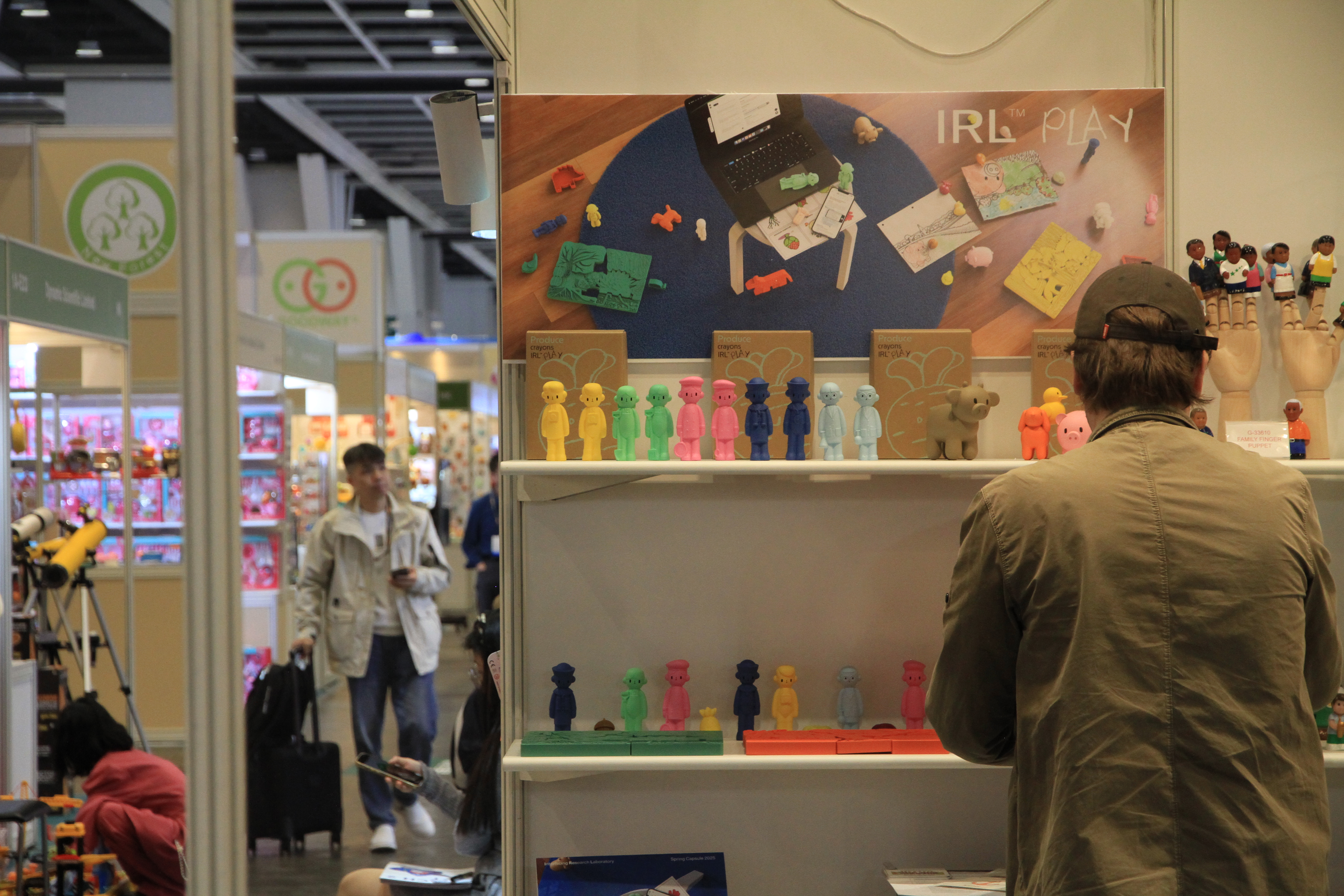
Deployment: UK, Southeast Asia (Hong Kong Toy Fair 2025)
Overview
IRL PLAYground is a cyber-physical education platform that integrates classroom software, physical toys, and AI into a single adaptive infrastructure. Physical objects function as data interfaces, classrooms operate as learning networks, and machine learning coordinates complexity across distributed stakeholders—enabling real-time pedagogical adaptation at institutional scale.
The system treats toys as networked sensors embedded with educational metadata. Each object undergoes photogrammetric capture to create 3D models linked to pedagogical context, supply chain provenance, and usage patterns. Teachers interact with AI-assisted interfaces that learn from correction rather than requiring retraining by specialists. Schools maintain data sovereignty while participating in aggregated learning networks.
Physical materials and digital intelligence as parts of the same adaptive feedback system.
Problem Space
Educational technology and physical learning materials operate as disconnected supply chains with incompatible data systems. Software platforms ignore material affordances, toy manufacturers lack pedagogical feedback loops, and teachers spend 40%+ of time on administrative coordination rather than instruction.
Existing "smart toy" approaches either reduce physical objects to IoT accessories for predetermined software experiences, or add sensors without pedagogical frameworks. Neither approach treats the physical-digital interface as infrastructure for adaptive learning where materials, software, and human judgment evolve together.
The technical challenge: build a platform supporting real-time multi-stakeholder coordination (teachers, students, distributors, manufacturers, administrators) while maintaining pedagogical flexibility, data sovereignty, and ethical AI governance at institutional scale.
Technical Architecture
IRL PLAYground implements a modular platform integrating adaptive learning software, object intelligence pipelines, and institutional data infrastructure:
Application layer (TypeScript, React):
Web-based interfaces for classroom management, content generation, and AI model supervision. Teachers correct system outputs through inline editing—corrections automatically retrain local models without requiring data science expertise. Real-time collaboration enables synchronous lesson planning and resource coordination across distributed teaching teams.
API & orchestration (Node.js, Python/FastAPI):
RESTful and GraphQL endpoints coordinate between frontend applications, AI services, photogrammetry pipelines, and institutional systems. Event-driven architecture enables asynchronous processing of computationally expensive tasks (3D reconstruction, embedding generation) while maintaining responsive user experience.
AI infrastructure (TensorFlow Lite, CLIP, fine-tuned GPT):
Edge-deployable models for real-time object recognition and content generation. CLIP-based visual similarity enables toy identification from classroom photos. Fine-tuned language models generate age-appropriate educational content. Crucially, all models support teacher-led retraining—educators mark incorrect outputs, system automatically adjusts without centralized updates. This architecture enables pedagogical customization while preserving privacy (training data never leaves institutional boundaries).
3D capture pipeline (RealityCapture, Agisoft Metashape, OpenMVG):
Photogrammetry workflow converts physical toys into queryable 3D assets with embedded metadata. Raspberry Pi camera arrays and structured light sensors enable classroom-scale scanning without specialized equipment. Automated processing pipeline handles image alignment, mesh generation, texture mapping, and metadata injection. Output: standardized 3D models linked to pedagogical taxonomies, material specifications, and supply chain provenance.
Data architecture (PostgreSQL, GraphQL schema):
Relational database with spatial extensions stores object geometries, usage patterns, pedagogical outcomes, and institutional metadata. GraphQL schema enforces typed relationships between physical materials, learning objectives, student cohorts, and curricular frameworks. Schema design enables federated queries across school information systems (SIS), distributor inventories, and manufacturing databases while preserving data ownership boundaries.
Hardware integration:
Interactive touch grids, sensor arrays, and camera systems transform physical play into structured data streams. Computer vision pipelines detect toy configurations, track interaction patterns, and generate usage metrics that inform both pedagogical dashboards and supply chain optimization.
Governance & observability:
Role-based access control (RBAC) with fine-grained permissions (teacher/admin/distributor/manufacturer roles). Complete audit trails for data access, model training events, and system modifications. Data visibility frameworks let institutions configure what information feeds AI training versus what remains strictly local. Structured logging and performance monitoring ensure system transparency and regulatory compliance.
Complexity as Infrastructure
The system sustains educational and manufacturing complexity rather than reducing it, implementing distributed feedback loops that connect human judgment, material affordances, and computational intelligence:
Adaptive learning loop: AI identifies knowledge gaps and proposes interventions based on usage patterns. Teachers accept, modify, or reject suggestions—each decision retrains local models. Intelligence emerges from contextualized practice rather than universal templates. No standardization enforced; system learns what works in specific institutional contexts.
Ethical governance loop: Educators train small, interpretable models aligned with local values and regulatory frameworks. Transparency built into data pipeline: teachers see what data trains models, students/parents control participation, administrators audit system decisions. Consent and data sovereignty are architectural requirements, not compliance additions.
Material intelligence loop: Physical toys become data nodes through photogrammetric capture. Each object embeds metadata defining pedagogical purpose (which learning objectives it supports), ecological origin (material composition, sourcing), and supply chain story (manufacturing location, distribution path). Creates living archive where material design directly informs pedagogical outcomes and vice versa.
Institutional coordination loop: Open APIs connect classrooms, factories, distributors, and education authorities into traceable networks. Enables circular supply chains (usage data informs manufacturing), evidence-based policy (aggregated anonymized patterns inform curricular decisions), and distributed innovation (schools share pedagogical strategies without centralizing control).
Each loop informs others: teacher corrections improve AI recommendations, improved recommendations reduce administrative overhead, reduced overhead enables more pedagogical experimentation, experimentation generates training data, training data improves manufacturer product-market fit, better products enable new pedagogical approaches.
Impact
Operational efficiency: 40% reduction in teacher administrative overhead across pilot schools (London, Hong Kong). Time savings redistributed to direct instruction and individualized student support. Automated resource coordination, attendance tracking, and progress reporting without sacrificing pedagogical flexibility.
AI interoperability: Demonstrated end-to-end integration across software (React/Node.js), hardware (Raspberry Pi sensors), and 3D capture (photogrammetry). Validated that physical object intelligence can inform digital learning systems at scale—first platform to close the loop between material design and adaptive pedagogy.
Cross-sector coordination: Engaged 15+ manufacturers, 8 educational institutions, and 5 distribution networks across UK and Southeast Asia through PLAYground Partner Programme. Co-developed ethical supply chain protocols ensuring material traceability, fair labor practices, and environmental standards. Proved that educational infrastructure can coordinate manufacturing without centralizing production.
Teacher-led AI governance: Established frameworks for educational AI including teacher-controlled retraining (educators correct AI outputs through normal use), data sovereignty provisions (schools own their training data), and interpretable model architectures (decisions can be explained in pedagogical terms). Demonstrated that adaptive systems can operate transparently at institutional scale without centralizing algorithmic control.
Real-time pedagogical adaptation: Built feedback mechanisms enabling classrooms to function as learning networks where teaching strategies, material resources, and AI capabilities evolve together. Reduced lag between pedagogical innovation and system capability from months (typical EdTech update cycles) to hours (teacher corrections immediately improve local models).
Circular material flows: 3D capture pipeline enabled 60% reduction in physical inventory requirements. Distributors use digital twins for catalog visualization, schools print-on-demand for specialized needs, manufacturers adjust production based on real usage patterns rather than projected demand.

Product Modules
Each module operates as both physical toy and data node—scanned, digitized, networked into living archive of learning objects:
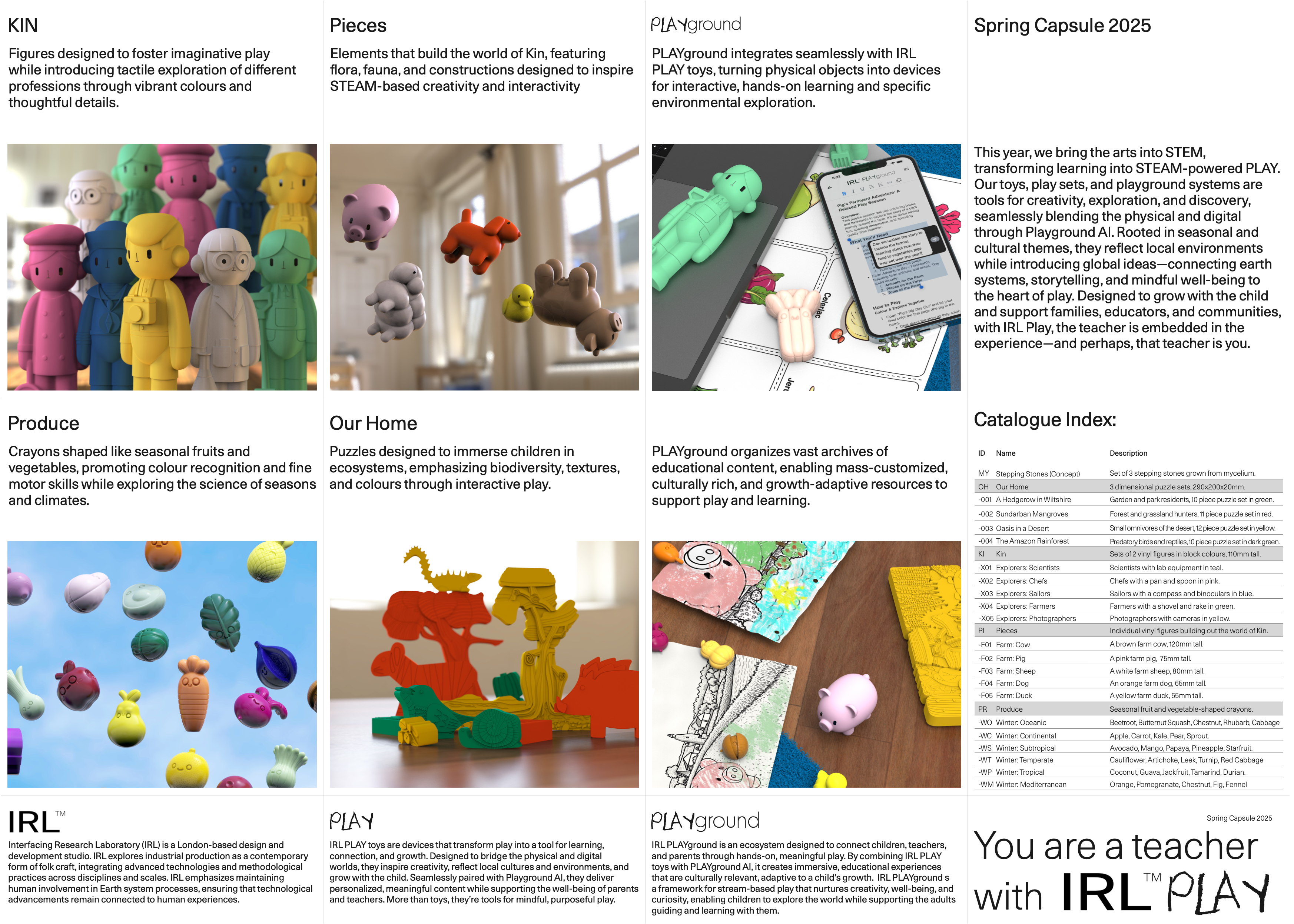
KIN: Modular structures teaching systems thinking and algorithmic reasoning through physical assembly. Demonstrates constraint-based design: limited components, infinite configurations. Photogrammetry captures each configuration, AI suggests variations based on learning objectives. Teachers use generated alternatives to scaffold problem-solving progressively.
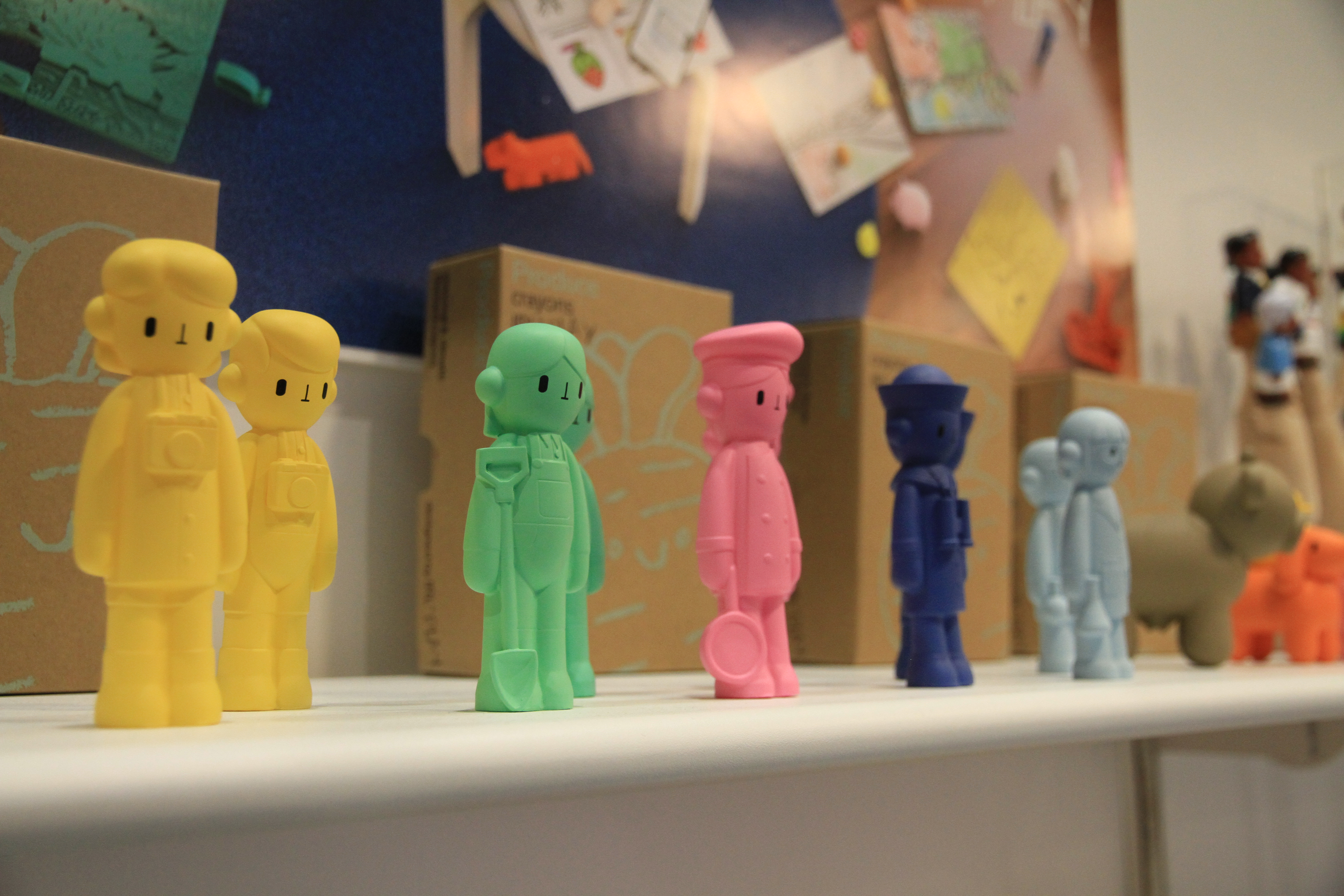
Pieces: Abstract character sets for AI-assisted storytelling. Deliberately non-representational—expands imaginative range beyond conventional animal/human figures. CLIP embeddings enable semantic search across narrative themes. Students construct stories, AI suggests complementary pieces, teachers curate story libraries that become training data for future recommendations.

Our Home: Spatial puzzle system integrating environmental design with first-principles ecological thinking. Physical pieces represent biomes, resources, infrastructure. Students construct functioning ecosystems under constraints (water availability, temperature ranges, species interdependencies). AI tracks configurations, identifies unsustainable patterns, proposes interventions—teaching systems thinking through embodied problem-solving.

Produce Crayons: Waste material transformation into creative tools. Demonstrates circular design principles through direct material experience. Supply chain metadata embedded in each crayon: waste source, processing method, material composition. Students learn ecological cycles not as abstract concepts but as tangible material flows they manipulate directly.

Team & Process
Founded and led interdisciplinary teams spanning software engineering, industrial design, pedagogy, and supply chain coordination. Managed partnerships with 8 schools (London, Hong Kong, Singapore), 15+ toy manufacturers, and 5 distribution networks.
Core technical team: 3 full-stack engineers (TypeScript/React/Node.js), 2 ML engineers (TensorFlow/PyTorch), 1 computer vision specialist (photogrammetry pipeline), 2 hardware engineers (sensor integration). Design team: 3 industrial designers, 2 UX designers. Pedagogy team: 4 curriculum specialists, ongoing teacher advisory board.
Process required building shared language across domains: designers learned data pipeline constraints, engineers understood pedagogical theory, teachers trained AI models, distributors integrated manufacturing metadata. Success depended on modular interfaces letting each stakeholder contribute expertise without requiring full-stack knowledge.
Pilot deployments shaped priorities: teachers valued AI that complemented judgment rather than replacing it, students needed toys functioning both physically and digitally (not IoT accessories), administrators required reduced coordination overhead (not additional dashboards), manufacturers needed usage feedback (not just sales projections).
Technical Stack
Frontend: TypeScript, React 19, Tailwind CSS
Backend: Node.js, Python (FastAPI), RESTful + GraphQL APIs
Database: PostgreSQL with spatial extensions, vector storage
AI/ML: TensorFlow Lite (edge inference), fine-tuned GPT APIs, CLIP embeddings
3D Pipeline: RealityCapture, Agisoft Metashape, OpenMVG, photogrammetry automation
Hardware: Raspberry Pi camera arrays, structured light sensors, interactive touch grids
Integration: SIS connectors, distributor APIs, manufacturing data exchanges
Infrastructure: Kubernetes deployment, event-driven microservices
Observability: Structured logging, performance monitoring, audit trails
Design Philosophy
IRL PLAYground treats education and play as infrastructure problems where care, data, and design co-produce intelligence. The platform demonstrates how AI can function as civic infrastructure: learning from social and ecological patterns rather than imposing external optimization.
Learning environments operate as adaptive systems where pedagogical strategies, physical materials, and computational intelligence evolve together through continuous feedback. Intelligence emerges from interplay between human judgment, material affordances, and algorithmic assistance—not centralized control.
Each classroom, toy, and networked interaction contributes to distributed learning systems where educational practice, manufacturing data, and institutional governance inform one another. The architecture enables communities to learn how to care rather than systems that manage behavior.
Physical materials carry pedagogical meaning through embedded metadata. Digital intelligence surfaces connections and possibilities without prescribing outcomes. Human judgment determines what matters, what to pursue, what to ignore. The platform coordinates complexity without reducing it—sustaining the irreducible interplay between care, cognition, and materiality that defines learning.
Intelligence should not manage the world. It should help the world learn how to care.